Saturday, May 21, 2016

Arkham Horror Mechanics

Matt Miller 

I've been playing a great deal of Arkham Horror, where a 5 or 6 on a d6 count as a success. Rolling 8 or 9 dice, it takes a bit to pick out successes. But estimating how likely something is to succeed is easy; every dice you roll gives you 1/3 of a success. Which makes it tempting to adapt as a base mechanic for an RPG. But I'd like more than two ways (1) Extra dice, 2) Extra success) to affect a players roll.

Matt Miller 
Arkham has a mechanic which asks you to roll a success. Mentally, it's hard to imagine how that affects the outcome, as it is deeply unintuitive. In effect, it squares your chances. If you roll 1 dice, your chance is 1 in 9 (1/3*1/3). But if you roll 2 dice...I become confused. The probabilities get wonky. Chance of getting 1 success, on X dice, squared, is the match. X*(1/3)^2...I think. If I have 5 dice, the chances of getting 1 success, twice, is not the same as the chance of getting 2 successes on 10 dice; the first is harder.

Timing and Initiative

Matt Miller
In Mayhem, in devising round-timing we started with a DnD based 10-count round, then expanded to a 12-count 'combat clock' (with 10+ combatants, players were 'tied' too often. But our actions take 5,6,7 or 8 ticks on the combat clock. Somewhat with the idea that people would not overlap too often. But it happened often, as initial position on the clock was set so that everyone started at a different number. But after several hours staring at number systems, I begin to wonder if was a good idea.
If starting position+action is the formula, 1+8,2+7,3+6 or 4+5 all wind up on the same tick on the combat clock. Yet starting all at 1 would not help: All 'fast' actions would wind up at the same tick-mark. Increasing the magnitude of numbers makes for more mental math, not using single digits, but the biggest problem seems to be the change-over, when 11+7=6
Rob Hicks 
Actually, we started with a 100-point combat clock first. Then went down to 50, then 30, then 10, then 12, assuming my memory serves. 
Matt Miller
That seems...not unreasonable. Why did we ditch 30? It was such a reasonable number. Divisible by 15,10,6,5,3,2,1...60 might actually have been even better.
Matt Miller
Given that the virtues of the Fibonacci sequence are that two numbers in it add up to a third number, I am thinking we'd have been better to use non-Fibbonacci numbers, viz: 4,6,7,9. Rounds take a long time, so I recall estimating HP on the basis that no battle should average longer than 10 rounds.  I tried a number of combinations, and they all overlap to some degree. 56789 just happens to overlap a great deal (20%) in the first two moves, which always bothered me. But alternate numbers are as big a head-ache: Either ratio between the highest and the lowest becomes too big, or the numbers become too big to do mental arithmetic with. 6-10 or 7-11 both have better ratios, but both still have the same 'overlap' problem. (7+11=8+10=9+9). Adding gaps between the numbers (1,3,5,7,9) fixes the overlap problem, but either generates speed ratio problems (9:1) or (using 5,7,9,11,13) mental math problems. The speed ratio was a problem because...players get bored when they take a 9 speed action, and someone else takes 9 1-speed actions. 
This was particularly true because there were a couple of effects in the game that adjusted speed slightly. Even a speed adjustment of 1 was HUGE at the lower ranges. An action at speed 3 becoming a speed of 2 is a massive boost across the combat wheel, where a 5 becoming a 4 was a little more reasonable and easier to plan effects around. Gave a boost without being a relative game-changer. 
Keith J. Davies(?)
...given 7, 9, 11, 13, your fastest is not quite twice as fast as your slowest. I'd probably consider a 1-20 scale for this (which happily aligns with a commonly-available die... not that that's really important)(and is still about twice as big as you're looking for) 
 Matt Miller 


Why is 12 better than 10, or 30?  Even fractions of APR, I guess. 60,30, 20,15,10, 6,5,4,3,2,1. So why not 24 or 18? Both are still 'hex'.
Rob Hicks 
Heuristics. Convenient Mental representations. People who do statistics for fun and profit tend to have no problem with number crunching, and don't understand why people who don't can't wrap their heads around them. 30 is as good as 24 or 18 for them. 10, however, is iconic in human math. Decimal counting system, fingers and toes, very easy. 12 only slightly less easy, but was a little kinder than 10 on the backend, and had the added parallel of the clock, both represented in the fact that it is a time-tracking system, and is something that people could reasonably count around. 18 and 24 have neither advantage.
Keith J. Davies
10 or 12 are good, 24 might be too big (but D&D 3.x-style initiative is d20+Dex mod+stuff and can easily reach that high).Perhaps use prime numbers for your speeds. Not 5, 6, 7, 8. 12-step scale, speeds 2 (really really super fast, probably not seen often), 3, 5, 7, 11 (really really slow, probably not seen often). If you start on phase 12 (*cough* HERO) you end up with everyone using the same speed actions hitting the same points and staying together. If you randomize, even slightly, then you might find that people at the same 'speeds' never overlap (if they didn't in the first place), while those acting at different speeds who overlap do so _once_ before they need to lap the field. That is, speed 3 and speed 11, once they sync, will need to go 33 phases before they sync again (11 actions and 3 actions respectively). These might be too far apart; being able to act so many more times than an opponent is pretty brutal. 30-phase rounds with actions 5*, 7, 9**, 11, 13, 17*** might be a better fit. 
* aligns with round, will always be on the same phases each round. Perhaps not desirable. 
** not prime, but _relatively_ prime 
*** maybe too big, less than two actions per round
Rob Hicks

Makes sense. Didn't think of primes, which is very interesting mathematically. Part of the reason actions varied from 5-9, (very fast, fast, average, slow, very slow,) was because the lower numeric end of the scale was trickier to balance for weapon damage. A weapon with a speed of 3 would be 3x faster than one with a speed of 9, where 5:9, was a little less than half as effective. Made the numbers easier to balance on weapon damage and such, when we were trying to get relative efficacy.
Rob Hicks
In the final release, we left it at 5-9, because ultimately the "tied" locations didn't affect things as much as they were initially thought to do. Everyone started on the same spot, and we broke the initial tie by going in order of Agility scores. When two characters tied, we broke the ties in the same way. When those ties were allies, it didn't usually matter. If one wanted to go first strategically, they lost nothing by letting one go before the other.
Matt Miller
We were also trying to keep it to keep the actions speeds to 'counting numbers' under ten. 
Andy Klosky
What is the purpose of having such a convoluted initiative system?  Does it make the game more fun? More realistic? Simpler for player or GM? Emphasize a type of combat, such as ranged or melee? Balance other game mechanics? 
Matt Miller
Mayhem was designed pre-4E DnD, so we made a lot of the same mistakes as 4E. So it has a very crunchy war-game style of mass combat, focused on melee. It also had a very extensive weapons list, with something like 60+ weapons, all of which had unique stats, yet all of which had to be roughly comparable in the amount of damage they did. 
Rob Hicks
The combat clock allowed an initiative system that was actually very easy to track and intuitive for players to run, but allowed for faster and slower actions in the game that had tactical meaning.  That in turn let us adjust the damage for various weapons, so that daggers fought like daggers. Less damage per hit, but faster attacks and more strategic maneuverability. A maul, by contrast, took ages to swing, but hit like a truck. It really, really improves the cinematics and style of combat, giving different play styles that highlighted different character concepts. In addition, working on a timing-based system, rather than a bonus-based system, meant that where you were on the map and when you were going to act next was strategically important. It gave a great deal of depth in combat for those that like the wargamey tactics style of play, but kept the mechanics still relatively simple and smooth for the people that were more interested in the style and cinematics of the game.
 Rob Hicks 
Ultimately, people were very aware of who had the better agility as combat went by, so ties on the combat clock didn't end up slowing things down at all, and it gave Agility a particularly nice perk for stat balance. Additionally, characters acting at the same spot on the combat clock often had other advantages. Team attacks, for example, getting an extra bonus for simultaneous whelm attacks, or for big cinematic clashes where two characters struck simultaneously, like a classic samurai duel.


Armor and Shields

Matt Miller
Players tend to forget penalties, so all numbers were bonuses, with no "maluses", so rather than -3 to +3, we had 0-7. Given that players could always default to 'bare hands' at +0, all weapons had to provide a better bonus than that, so our range was only +1..+7. But the 'big numbers' made weapon very difficult to balance, so in the final list, the numbers were much compressed, even as it made weapons much more similar to one another than I would have preferred.
Rob Hicks 0 to +3 is what we ended up with for skill bonuses. +3 ended up being rare.Ultimately, for simulation, we ended up doing Jake's method of multiplying the damage of a weapon at a specific die result by the probability that such a result would happen and summing them for average damage. That let us calculate relative bonuses for two opposing dice rolls and two opposing bonuses. (What if your opponent has a shield? For example.)

Keith J Davies Ah, shields are easy. I think. "Shields must be splintered!" rules: sacrifice your shield to prevent a hit. Done.

Or, since armor is a function of coverage (die size: d8 means it applies half the time, d12 means it applies 2/3 the time) and quality (leather is 1 die, steel plate is 3 dice), a shield might simply count as another die of armor (or, more likely, give you new options in the fight; as far as I'm concerned a shield is actually a weapon, specialized to defensive purposes).


Rob Hicks  Matt Miller always pushed for shields as a piece of armor, while I always pushed for shields to be treated as a weapon. My logic to justify my stance was to buy a padded shield and attempt to beat him with it. tongue emoticon

Matt Miller My reply was to build a viking shield, and then Rob attempt to beat me around it....which left only my head and legs uncovered, demonstrating that the Greek hoplite gear (Helmet, shield, greaves) is (1v1) astonishingly effective.

Matt Miller I had forgotten the wrinkle of different defense numbers.

Keith J Davies In previous efforts, I've found that it often is beneficial to treat a shield as weapon specialized for defense...it let me collapse a surprising amount of mechanics.

Matt Miller Yeah, the combination of armor+shield can form a near-wall. Which, while realistic...isn't that enjoyable for gameplay. Armor mechanics are a head-ache all their own.

Friday, March 11, 2016

what do the people in your game do with the ships?

James Mullen 
When I was designing my Space Pirate Game (never finished it) I only acknowledged two types of vessels. Fighters (Ships up to about four times the size of the Space Shuttle), and Capital Ships. This was done mainly because a) Space Dogfighting is fun and b) Space Combat is not fun when you don't get to do anything. So all players had Fighters, and were assumed competent. Then I made all the Capital ships basically dungeons which the Pirates boarded.

While I understand the want and need of different classes of ships, you really just need to ask yourself what do the people in your game do with the ships? If your ship is just a moving castle (Like In Battlestar Galatica), then you don't actually need a lot of details for opposing ships. What you need is reasons that they would avoid each other or get in conflict with each other, and then a system in which they would avoid conflict.

In less cinematic universes (Say, Honor Harrington's series), combat is almost over before people even start it. Computers calculate everything, fire, and then calculate the next results it needs to launch. That means the emphasis of the role playing is disaster management and negotiations, with some tactical roles thrown in. Class of ships is less necessary as lethality of ships. As our history has shown, even very small ships can cripple large ones.

ORE (One Role Engine)

Matt Miller:
Uses d10, could likely use d6. Biggest problem I can see is the dicepool problem, where you've got 10 dice, arranging them into sets is time-consuming. Not sure I understand 'Hard Dice'. They act sort of like criticals, making a successful roll even more successful? Expert dice are clear--pick a number when you get them--seems highly suitable for 'specialist' abilities. Wiggle/Trump/Master dice boost the...'width' of any set, making the action faster, but not necessarily more successful...

Jesper Anderson: A hard die is always 10. So if you have two hard dice and four normal dice, you roll 4d. You are ensured to always have one set of 2 10's in that case, but it could be wider, or you could have more sets. Wiggle dice are really powerful. You get to pick their value after you have rolled. If you have only one wd it will ensure you get at least one success. Arranging in sets is not time-consuming. It's pretty much instant, even with a 9d pool.

Travis Casey: I've had Godlike since it came out, but never gotten to play it. I have, however, run a few sessions of A Dirty World, which uses the same dicing system. We found that quite often, rolls gave no matches at all. Part of this is probably because ADW is meant to be a gritty, low-powered game, and quite often, my players were rolling 4 dice or fewer. This also meant that the fun features of the system, where you get multiple sets and have to choose how to allocate them, almost never came up. If you're going to use the system, I recommend making sure that attributes are assigned in such a way that players tend to have fairly large dice pools, in the 6+ dice range.
Jesper Anderson 
... or have wd and hd. That makes a difference!

Travis Casey: Yeah, I'm sure it would have. ADW doesn't use those aspects of the system, though. I might do some thinking about how to incorporate them, for when I use the system again. Since it *is* low-powered, I as GM didn't really have a problem with the constant "no success" - to me, it meant the PCs just hadn't accomplished their goal yet. A few of the players were noticeably frustrated, though, so I had to reassure them that no match doesn't mean failure when you're rolling against an opponent.We only got to play three sessions or so, and by the third one, I think they were settling into the system comfortably. It did take an "adjustment period", though.

Jesper Anderson Yes, with 4d you will get a match half the time or so. It's how the system works. Even in Godlike most rolls are with low pools, and the attrition rate tends to be very high. ORE as a whole takes an adjustment period. My present group has not tried it, and they have a firm opposition to it. Which is rather strange, considering how many weird systems we've successfully run.

Scott Rhymer 
I've been playing in a Wild Talents game, and while the mechanics work adequately, the wiggle/hard/other dice was -- IMO, so take that as you will -- overly complex. We all found character creation a hot mess. The general consensus for our group is that, in trying to make things simple and fast, it paradoxically introduced more complexity than it probably needed to.

Travis Casey 
I do recommend checking out the "A Dirty World" version - it's very different from Wild Talents/Godlike, with only the resolution system being shared. Character creation is totally different, and much simpler... and what you do with the outputs of resolution is also very different. From a game design point of view, ADW vs Godlike is an excellent example of how different two RPGs can be while sharing the same resolution system.

Paul Mitchener 
I've run a lot of Wild Talents and Reign. The One Roll Engine is one of my favourite mechanics.
And the Wild Talents settings (I'm thinking of Kerberos Club and Progenitor especially) are fab. Though the writer of Blood of the Gods is a complete jerk, so that's better missed.

Short history of naval engagements

Pre-cannon, it's all about ramming and boarding. Bigger ships hold more rowers, and move faster, and carry more troops. Galleys are up to three decks tall. Throw in a ballista to act as a harpoon. ...And that continues pretty much until the age of sail, when a wind-powered ship can outrun a galley over a longer period of time.

Age of sail, add very large fore and aft castles to ships, as archery platforms. Then add cannon to these platforms. Cannon are really important, because they allow you to sink a ship, or hurt people on board, without needing to ram or board. Cannons on the fore and aft-castles intermittantly overweights ships an causes them to capsize and sink (ie Mary Rose). At somepoint, someone puts the cannons as low on the ship as possible while remaining above water. This proves very effective. Over time, ship design improves, with ships getting longer, and fore-and-aft castles are reduced in size. Cannon technology improves, so cannon are less carronades (mortars) and more 'long guns'. This makes is possible to fire horizontally (at least for short distances). This also makes it possible to put multiple decks of cannons on a single ship. In some cases, for the Spanish, this means up to four decks of cannons on a single ship.

SHIP OF THE LINE OF BATTLE ('Battleship')

Big ships are expensive ships (hence the term 'capital ship'--it can't be bought outright, even by governments, and must be financed. At some point, someone comes up with two alternatives to bashing capital ship into capital ship: Fire ships, which cost almost no money, and gunboats. Fire ships are self-explanatory. Gunboats are small cheap ships with oars and very large guns. One hit destroys them, but they can destroy a capital ship with one hit. Thus emerges one of our fundamental tensions in naval warfare, that between big, expensive 'capital' ships, and cheap disposable flotilla ships.

There is also a mid-range option: Cheaper than capital ships, better armed/armored than armed merchant ships. For the Napoleonic Age of Sail, those are 'frigates'. In WW1 parlance, they analogous to 'cruisers' - cheap enough to be numerous, numerous to be deployed all over the place. Battleships tend to stay put, as a static threat to another fleet of battleships.

In WWI, the equivalent to the 'gunboat' is the 'Torpedo Boat', which are so successful that they invent an entire new type of ship to deal with it,the "Torpedo Boat Destroyer" or 'Destroyer': Small ships with big engines and enough weaponry to wreck a (disposable) Torpedo Boat.

Battleships themselves get smaller, as a result of the increasing destructiveness of cannon, which now fire high explosive (HE) shells, which not only do kinetic energy damage, but also blow up when they hit. Accuracy is still lousy, but a half a dozen hits can sink even a capital ship. WWII, you see aircraft carriers. They spell the end of the Battleship Era (read up on the Battleship Yamamoto for case in point), simply by having a greater range. A plane can bomb a ship from out of range of the best ships guns. But aircraft carriers are extremely expensive--only the most advanced nations can field them. So the less advanced nations go back to the 'Fire-ship/Torpedo Boat' strategy, this time as Attack Submarines. Cheaper to build, capable of destroying capital ships, even aircraft carriers. So Destroyers get repurposed as sub destroyers, with sonar and the capacity to drop 'depth charges' to destroy subs.

At which point, battleships are on the way out. Aircraft carriers win all the way. (Being the biggest, baddest battleship ever, and stacked with machine gun-turrets did not help the Yamoto)
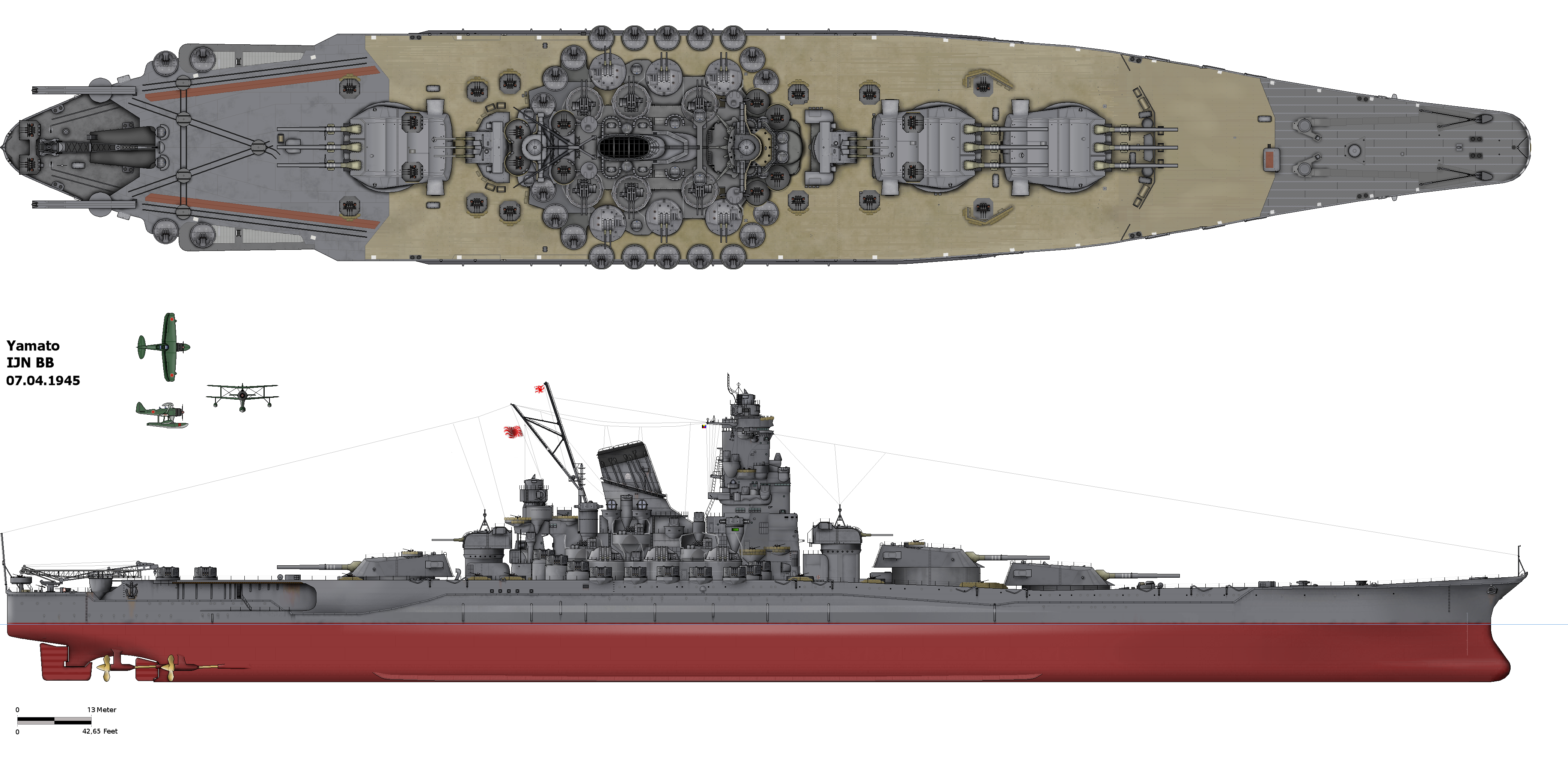
Some cruisers still exist, serving as 'pocket battleships' in places far from aircraft carriers. Destroyers screen aircraft carriers from subs. So there emerges a burning need to 'beat' destroyers so you can get at the aircraft carriers. Thus emerges the 'guided missile destroyer'. Missile technology, mid 1980's, reaches the point with cruise missiles and guided warheads that you can file a missile from tens of miles away, and be reasonable sure of hitting something, and likely sinking it. And that's about the current state of affairs. Current efforts include the Arleigh Burke class of nuclear destroyers, which are a) harder to hit, and b) use lasers as anti-cruise missile defense systems. For future combat, the effects of drone systems is of special interest, as drone aircraft are capable of all sorts of things humans aren't, like lingering over an area for days, and being launched from much smaller carriers. They also end any type of top-gun style dogfight versus humans, because they can do aeronautic maneuvers that would cause a human to pass out or die.

Star Trek is WWII era naval military. The enterprise is (arguable) a cruiser.
Star Wars is Vietnam era naval military. The Death Star is an aircraft carrier. The X-wings are 'Torpedo Boats'.

On working for Free

Q: "Can someone do this for me?"
A: "Is there money involved?"
Q: "No..."
A: "Then you have do it yourself. Here's some advice on how".
A2: "...And some related brain-dumping".

Dalton Calford
Ok, that is your problem. No brain dump as that is your income and skill set you are giving away. It sounds harsh, but, you need to understand that your skills, talents and experience are valuable. It is not just what you produce that has value. Ask yourself - how much has it cost you to get to the point in life to be able to do the work they want? Now you are willing to give all that away for free?

I currently need a digital artist who is able to produce svg/dxf files, but, I am not actively looking as I know that I am not in the financial position to offer what the job deserves. I will have the capital in time, but, I am no more willing to have an artist work for nothing, than I am willing to work for nothing myself.

Darrell Hardy 
If you can take five minutes to point the person to some useful tutorials, or give them the first three things they should know, you make a positive impact that can (a) bring them back as an actual client when they have money or (b) have them refer you to potential clients who do have money.

Dalton Calford 
There is a difference, a few pointers is not a brain dump.